Philip Roth’s attempted runaway
The Plot Against AmericaPhilip Roth’s attempted runaway is a deliberate, carefully prepared effort to leave home and become an orphan, not the sleepwalking episode his parents later took it to be. After a night of anxious calls prompted by Walter Winchell’s disclosures, Philip slips out in Seldon Wishnow’s clothes, carrying his treasured stamp album, and heads toward an orphanage. The escape ends with Philip injured and unable to remember what happened, but Seldon’s pursuit brings help in time to save him. Philip survives; his album does not return with him.
Background and Decision
The attempt follows an evening when Winchell’s revelations unsettle Philip’s family and their circle. Philip hears his mother repeatedly answering calls from friends, assuring them that the news is terrible but now public, and saying that Herman will call after the broadcast. His parents spend hours talking and returning calls. The house’s usual rhythms are displaced by the urgent radio program and the phone, and Sandy is also awake in the bedroom as Philip pretends to be asleep.
Philip waits until the household has settled. Only after he is satisfied that his parents and brother are sleeping does he get up, unlock the back door, cross the cellar, and reach the family’s storage bin. He describes the decision as considered rather than impulsive: he knows why he is leaving and understands that the attempt is dangerous, even if he cannot know whether it will succeed. In retrospect, the contrast is sharp between his parents’ later explanation that he acted unconsciously and his own insistence that he was fully awake and purposeful.
The political atmosphere gives the plan its urgency, but Philip’s aim is not to join a movement or to claim a place in history. He rejects a teacher’s suggestion that school lessons about the Underground Railroad inspired a grand escape. Sandy, by contrast, has been drawn toward the possibility of participating in history on a larger scale. Philip wants the opposite: the smallest possible life, as a child without a family. Becoming an orphan is the specific objective he imagines for himself.
The Escape and Its Objects
In the storage bin, Philip changes out of his pajamas and into Seldon’s pants. He remembers trying to steady himself against fear as he passed Alvin’s empty wheelchair and imagined the presence of Seldon’s deceased father. These details belong to the child’s apprehensive preparation, while his purpose remains practical: to leave unnoticed and reach the orphanage grounds.
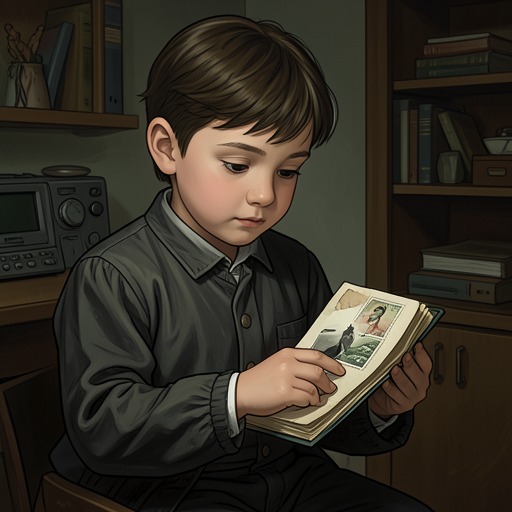
There is one possession he cannot bear to leave behind: his stamp album. Before going, he quietly retrieves it from beneath his socks and underwear in his dresser drawer. The album is not simply something he values; he fears it might be broken up, discarded, or given intact to another boy after his departure. He also takes a musket-shaped letter opener bought at Mount Vernon, which he used to open the stamp-approval packets sent to him by H. E. Harris & Co. The objects make the plan tangible: he is leaving home, but he carries part of the private world he has built there.
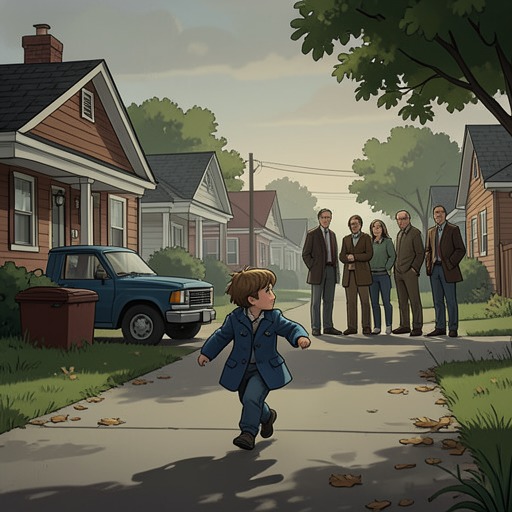
Philip remembers no more of the journey than setting out down the empty street toward the orphanage. His later account therefore distinguishes his clear intention from the blank in his memory: he knows why he left, but not the precise sequence that brought him to the place where he was found. He had reached the orphanage woods after passing along Summit Avenue and across the high-school playing field toward Goldsmith Avenue. The route led him through an unlatched gate and into the wooded grounds, but the final mishap was not something he could recall himself.
Seldon’s Intervention and the Return
Seldon, who had noticed that his clothes were missing, hears Philip on the back stairs and follows him. He keeps his distance as Philip crosses the route toward the orphanage, then witnesses the accident in the dark. Philip has startled the orphanage’s two workhorses; as he tries to get away and return toward the street, he falls and is struck on the back of the head by a fleeing horse. The account establishes the seriousness of the situation without making Philip’s injury the point of the adventure: he is left unconscious, and without help could have remained undiscovered.
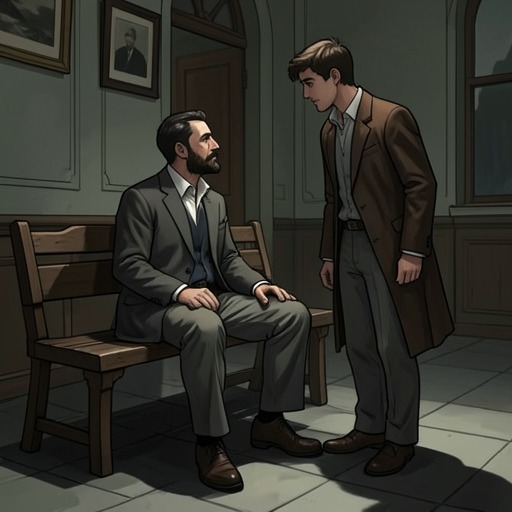
Seldon runs back to the house, wakes Philip’s parents, and directs them to the spot. Close to three in the morning, Herman and Bess reach Philip and wait for an ambulance. His mother uses a towel to stop the bleeding, while his father covers him with a picnic blanket from the car to keep him warm. His parents organize the rescue, but the narrative gives Seldon the decisive credit for finding them and leading them to Philip: he saved Philip’s life.
Philip wakes in Beth Israel Hospital with his parents beside his bed and a doctor treating him. The examination rules out a skull fracture and lasting neurological damage; the doctor attributes his severe headache and amnesia to a concussion. Philip remains under observation through the day and night, is discharged the next morning, and stays home from school while the headache subsides. His memory is otherwise intact, but he does not recover the memory of the blow or the events immediately leading to it.
Aftermath and Significance
The escape changes Seldon’s sense of his own importance. He had thought Philip had lost the clothes; discovering that Philip had deliberately taken them makes Seldon part of an improbable adventure. He recounts the episode at school, emphasizing his role as witness and rescuer and showing his scraped feet after twice making the journey between the orphanage woods and the house. The event gives him, in his own eyes, the status of a daring boy who has attracted a hero’s attention.
For Philip, the return is marked by shame rather than triumph. He is distressed by the story’s circulation and by Seldon’s excitement, but the deepest loss appears only after he gets home and dresses. The stamp album is gone. He had not remembered taking it to the orphanage, and its absence makes the escape’s cost newly concrete: the possession he feared leaving behind has disappeared all the same. In his account, that loss is both comparable to and unlike Alvin’s lost leg, a comparison that registers the album’s importance without turning the child’s material loss into the same experience as bodily disability.
The episode brings together intention and accident without confusing them. Philip chooses to leave, chooses the identity he hopes to assume, and chooses what to carry; he cannot remember the accident that ends the plan, and he depends on Seldon to get home alive. The result is neither a successful escape nor a simple return to ordinary childhood. His ambition to disappear into orphanhood fails, while the missing album and Seldon’s newly enlarged role remain as consequences he must confront after the physical danger has passed.